


After passing through the precious moments of childbirth and breastfeeding, many women find themselves distressed by the changes in their body shape when looking in the mirror.
Especially due to breasts that have hollowed out at the upper pole and lost firmness overall, becoming loose,
"Will breast implants alone bring them back to how they used to be, or do I also need a breast lift?" Patients often visit our consultation room with this very concern.
To give you the bottom line first:
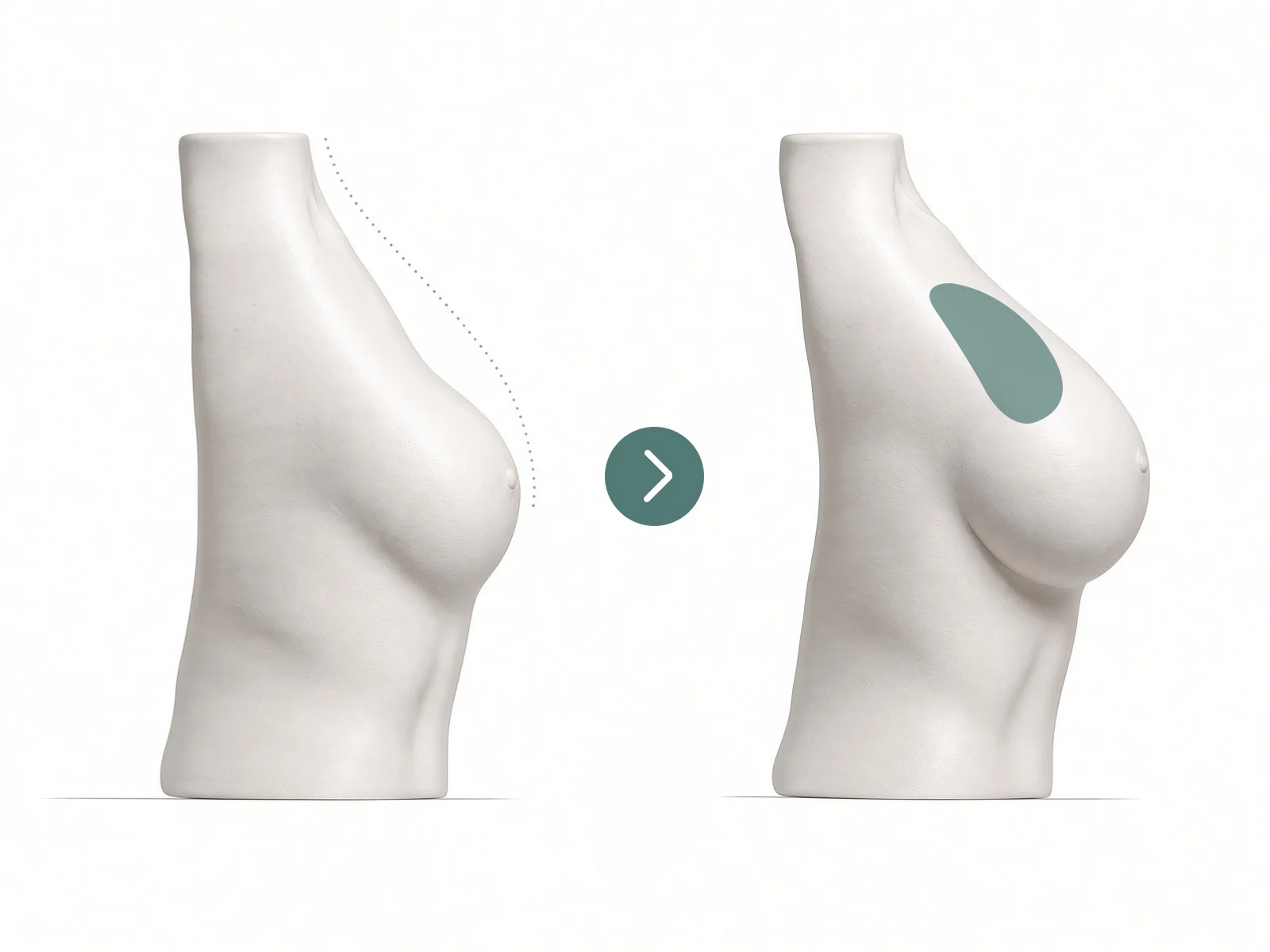
'Deflated breasts' with volume loss only in the upper pole can be fully resolved with implant surgery alone,
whereas 'sagging breasts' where the entire breast tissue has drooped downward require a breast lift (mastopexy).
The single most important criterion in determining the right surgical approach for you is the 'position of the nipple.'

1. Why do breasts lose firmness and become loose?
Skin elasticity in the breasts begins to gradually decline starting from the late 20s.
For those who originally had a B cup or larger, the natural weight of the breasts makes them more susceptible to the effects of gravity.
On top of this, during pregnancy and breastfeeding, glandular tissue expands and then rapidly shrinks,
leaving behind excess skin and laxity—much like a deflated balloon.
Whether only the upper breast appears hollow, or the nipple and the entire breast tissue have drooped downward,
will completely change the surgical approach.
2. Self-assessment criterion in front of the mirror: 'Nipple Position'
Here is a simple way you can check at home.
Stand sideways in front of a mirror and check where your nipple is located relative to the 'inframammary fold' (the crease where the breast meets the abdomen).
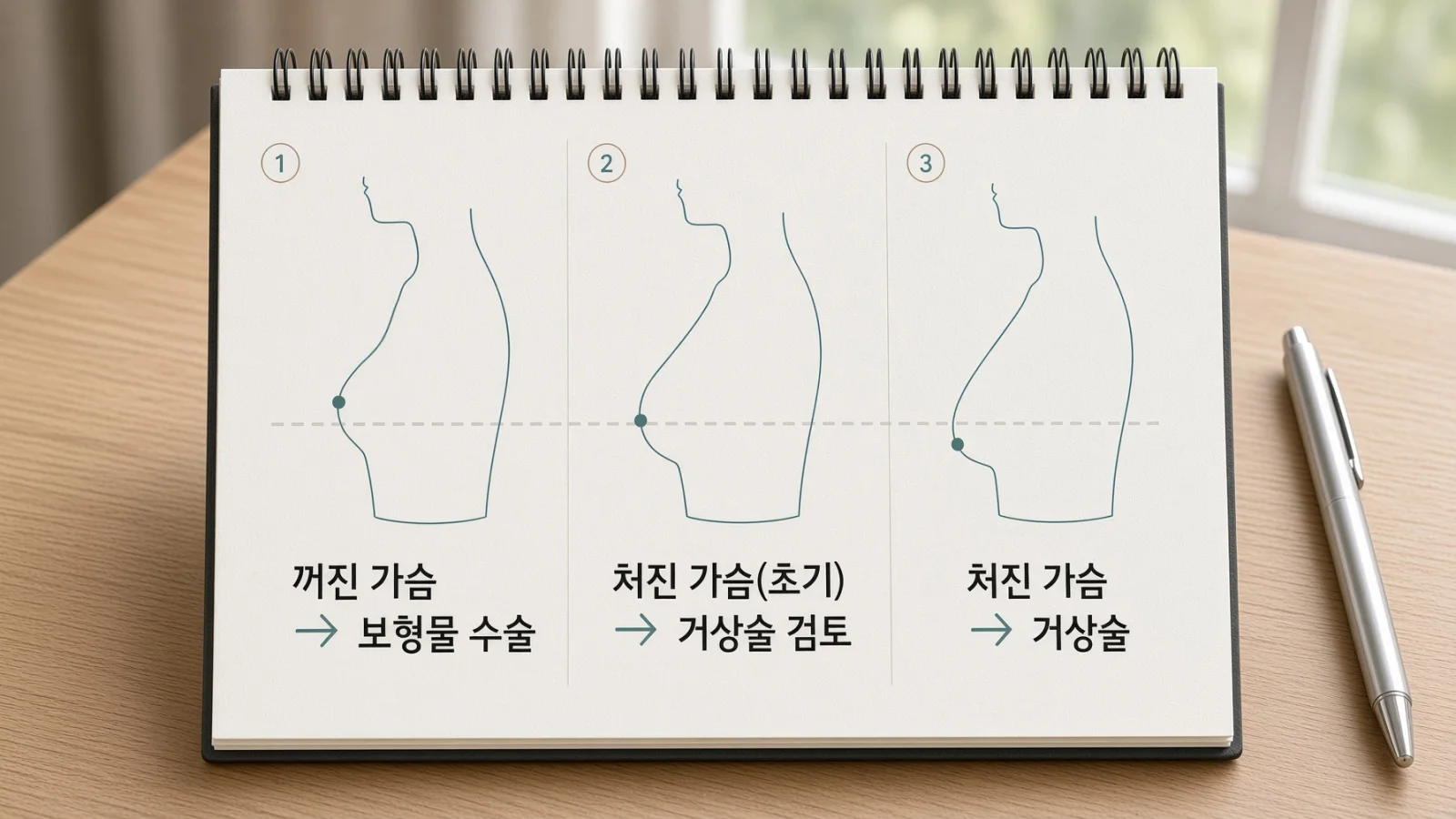
- Self-assessment based on nipple position
If the nipple points upward above the inframammary fold, it falls under 'deflated breasts' where some elasticity is preserved.
Conversely, if the nipple sits at the same level as the fold or has descended below it, pointing toward the floor,
it is medically classified as breast ptosis, or 'sagging breasts.'
Of course, skin elasticity and actual anatomical distances vary significantly from person to person,
so the safest way to ensure an accurate diagnosis is through precise measurements during an in-person clinic visit.
3. Deflated breasts can be naturally restored even with small implants
If the assessment indicates 'deflated breasts,'
you can expect satisfying results through breast augmentation alone, without the need for a lift.
In such cases, a certain amount of the original breast tissue often remains,
so rather than inserting unnecessarily large implants, simply filling the hollowed upper pole with a modest-sized implant
can beautifully restore both volume and silhouette.
The placement pocket for the implant (subfascial, dual-plane, etc.) is determined based on your current skin thickness and tissue condition.
If the tissue coverage is adequate, the subfascial approach—which leaves the muscle untouched—allows for shape correction with a relatively gentle recovery.
In addition, when choosing an inframammary fold incision for post-pregnancy breasts that have slight skin laxity, the scar naturally hides within the breast contour,
and because skin tension is reduced, the scar tends to heal very cleanly.
4. Why a 'Breast Lift' is essential for sagging breasts
If the nipple has dropped below the inframammary fold, simply increasing volume with implants can actually work against you.
Just as pumping more air into a deflated balloon does not raise its position, merely adding volume leaves the nipple still pointing downward,
only making the breasts appear heavier.
Just as a facelift is used to lift sagging facial skin, sagging breasts also require a mastopexy (breast lift) to excise stretched skin and reposition the nipple to an anatomically ideal height.
If ptosis is accompanied by a significant loss of overall volume,
combining a lift with implant insertion can restore both firmness and fullness simultaneously.
5. Don't forget to check 'Nipple Size' after breastfeeding
One easily overlooked aspect when reshaping the breast line is nipple size.
During the breastfeeding process, nipples often become elongated or enlarged,
and even if the breast volume and contour are beautifully corrected, an excessively large nipple can make the overall proportions look unnatural.
Evaluating whether a nipple reduction should be performed in conjunction during your consultation can help you achieve far more harmonious results.
Five essential points to check before your consultation
- Whether your nipple sits above or below the inframammary fold
- Whether you need implants alone or a combined breast lift, along with the medical rationale
- The optimal implant placement plane (subfascial, dual-plane, etc.) suited to your skin thickness and tissue quality
- The location and extent of any incisions and scars should a breast lift be performed
- The necessity of concurrent nipple reduction for overall aesthetic proportion
A board-certified plastic surgeon with extensive experience in breast surgery will not simply recommend increasing size;
they should accurately diagnose the current degree of ptosis and provide transparent guidance
regarding the extent of scarring if a lift is required.
Related procedure