

Many of you may have felt quietly self-conscious and concerned
every time you looked in the mirror and noticed differences in the size or shape of your breasts.
However, there is no need to worry too much.
In fact, breast asymmetry is a completely natural feature present in virtually all women.
There is a well-known quote in the preface of a breast surgery textbook:
“A woman’s breasts are sisters, not twins.”
Just as the two sides of our faces are subtly different,
breasts that are identical like a mirror image rarely exist anywhere in the world.

If you are considering breast augmentation to correct asymmetry, however,
it is essential to understand in advance what surgery can effectively balance and where natural limitations lie.
Differences in breast volume, inframammary fold height, and rib cage projection
can be balanced quite naturally through surgical technique and implant selection.
On the other hand, because the position of the nipple is fixed directly on the skin, repositioning it without leaving noticeable scars has its limitations.
That is why I always share this perspective with patients in my consultation room:
“The goal of breast asymmetry correction is not 100% mathematical symmetry,
but creating a natural, aesthetically pleasing balance that looks harmonious to anyone.”
1. Why are my breasts asymmetrical?
Breast asymmetry generally stems from congenital skeletal structure and daily lifestyle habits.
Natural differences caused by the heart
Because the heart is situated on the left side of our body,
the left ribs and thoracic cage inherently tend to project slightly more forward than the right side.
In my more than ten years of treating countless patients, I have encountered only one patient whose heart was on the right side;
almost everyone has a slightly more prominent left rib cage.
Postural and occupational habits
Those who spent prolonged periods sitting at a desk studying during their growth years,
or those in professions that predominantly use one arm and the upper body—such as hairstylists or instrumentalists—often develop accompanied scoliosis.
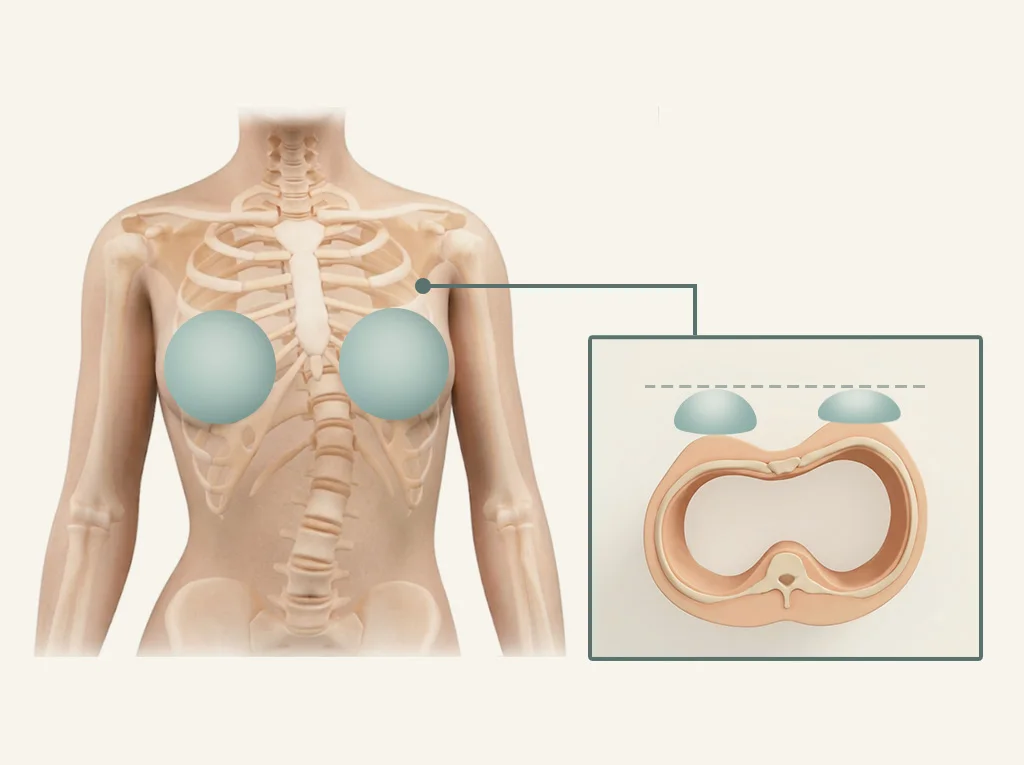
When the spine is slightly curved, the ribs on one side protrude more, which in turn leads to asymmetry in the overlying muscle and skin tissue as well.
2. Three things that can be effectively balanced with implants and surgical techniques
Differences in breast volume (size)
This is the aspect that can be corrected most cleanly and effectively.
After carefully measuring the native tissue volume of each breast,
we insert implants with different volumes (cc) on each side to balance the overall breast volume.
Differences in inframammary fold (IMF) height
We adjust the level of the fold by differentially tailoring the extent of the implant pocket created on each side.
There is an important detail to keep in mind here.
If there is a significant discrepancy between the lower folds and we forcibly lower one side too much to match the heights,
the original fold can persist, resulting in an unnatural "double bubble" deformity with two overlapping creases.
Therefore, we recommend harmonizing the levels within a safe range that does not deviate drastically from the native fold.
Differences in rib cage projection
Since we cannot alter the underlying bone itself, we compensate for this with differences in implant profile (projection).
While keeping the base width of both implants similar,
we place an implant with higher projection on the side where the chest wall is more recessed,
thereby achieving a balanced, harmonious outward projection.
3. Limitations and how to complement them: Nipple position & Fat grafting
As mentioned earlier, differences in nipple height or distance from the midline
are difficult to adjust significantly without skin incisions.
It is best to examine this together in front of a mirror with your surgeon during your preoperative consultation
to clearly understand the extent of natural improvement that can be achieved.
Furthermore, because implants inherently create volume within a rounded contour,
it can sometimes be challenging to fully smooth out subtle height differences in areas untouched by the implant, such as the upper cleavage or minor irregularities along the lower contour.
In such cases, adding a small amount of autologous fat grafting to deficient areas allows for a far smoother, more refined contour.
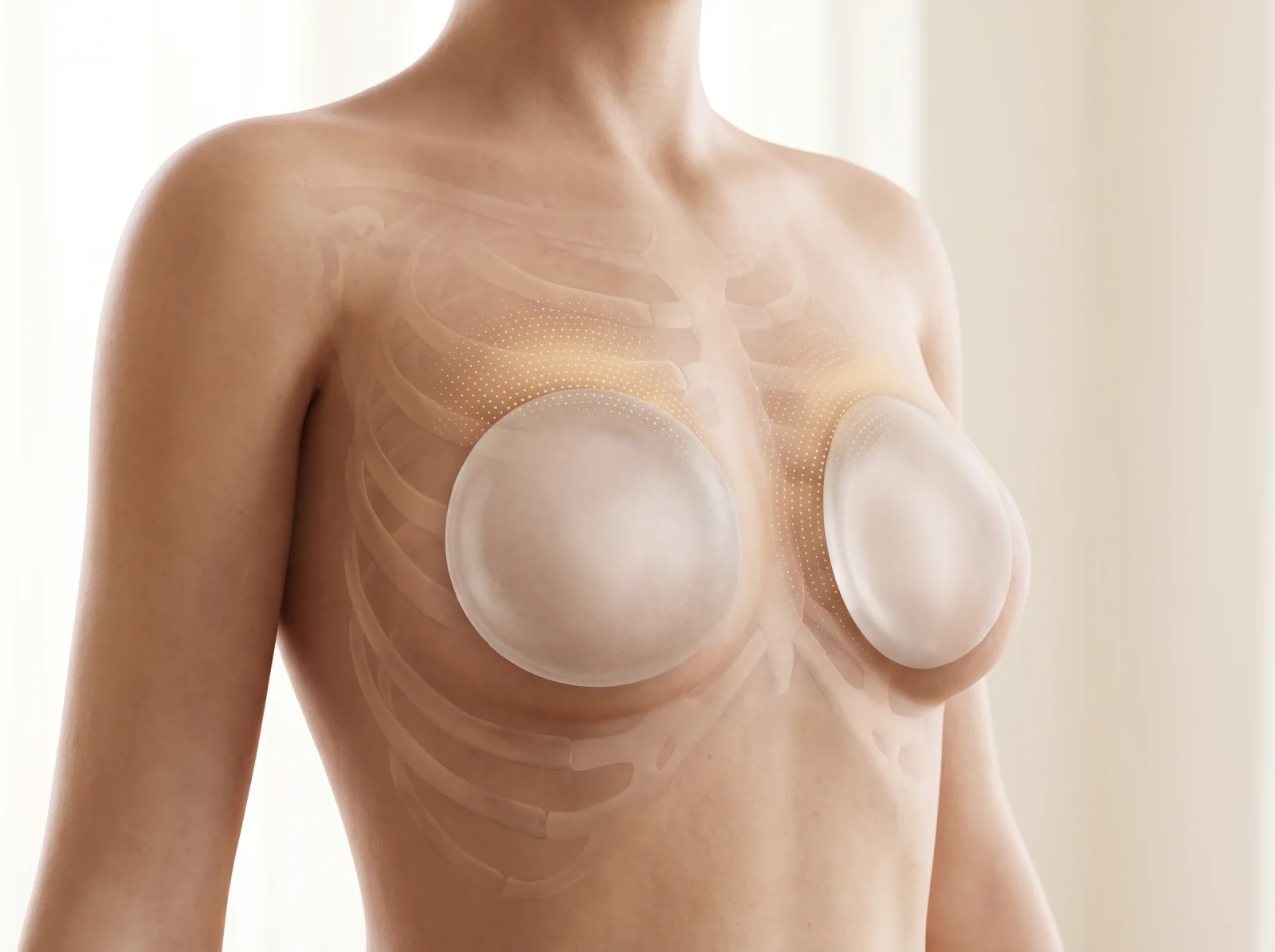
In practice, the degree of asymmetry observed when standing during design often differs subtly from what is seen when lying on the operating table.
For this reason, during surgery, we first insert sizers (trial implants) to meticulously inspect the bilateral balance with our own eyes,
and then determine the optimal final implants and any necessary amount of fat grafting.
Key takeaways to remember before surgery
Differences in volume, lower fold height, and rib cage projection can be balanced with implants,
while delicate contour differences beyond the implant margins can be naturally complemented through fat grafting.
Since fully correcting nipple position without scarring has its limits,
aiming for a beautifully proportioned, “harmonious, pleasing asymmetry” rather than rigid mathematical symmetry will bring you far greater satisfaction with your results.
Related procedure